I share insights on the challenges of managing chronic illness in a system not designed for everyday life—from medical debt to unmet needs. I turn complex evidence into stories and actionable solutions.
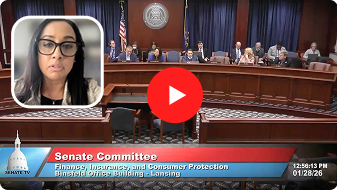
Invited Testimony on Medical Debt Protections and Consumer Financial Risk
Provided invited testimony before the Michigan Senate Finance, Insurance, and Consumer Protection Committee in Lansing, MI on January 28, 2026, addressing medical debt protections and consumer financial risk in relation to Senate Bills 449–451. The testimony contributed to ongoing policy discussions on financial safeguards and the broader impact of medical debt on individuals and households.
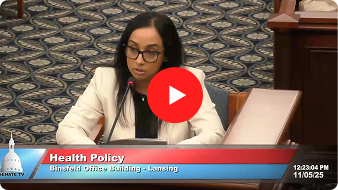
Invited Testimony on Hospital Financial Assistance and Medical Debt
Provided invited testimony before the Michigan Senate Health Policy Committee in Lansing, MI on November 5, 2025, addressing hospital financial assistance policies and their role in mitigating medical debt in relation to Senate Bills 701–702. The testimony informed policy discussions on improving access to financial support and reducing the burden of medical debt on patients.
Media and Press
video features
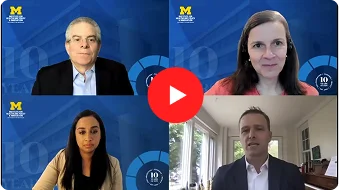
Health Care Reform: A Conversation with U-M Experts
On May 20, 2021, with a Supreme Court ruling expected soon on a challenge to the Affordable Care Act, and other activity at the state and federal level on many health policy topics, a panel of University of Michigan experts gathered virtually to give updates and answer questions.
University of Michigan and Leading Health Organizations Join Forces to Improve Health Equity
The University of Michigan School of Public Health, American Heart Association, American Cancer Society and American Diabetes Association have joined forces in a four-year, $25 million Bank of America-funded initiative to improve health outcomes for Black, Latino/Hispanic, Asian and Indigenous communities across the US.
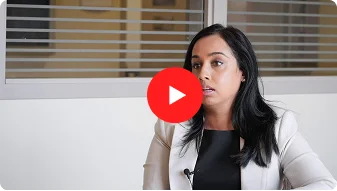
Dr. Minal Patel discusses prescription medication costs
Minal Patel explores how high prescription costs harm patient health by leading to poor adherence, worse outcomes, and more hospitalizations. Patel advocates for a nonpartisan group to develop evidence-based pharmaceutical reforms and highlights the need for lasting policy change.
Addressing unequal treatment in healthcare | Three online courses
Recent events have again highlighted the deep-rooted racism in systems like healthcare. To drive change, we must equip learners to address these inequities. This MOOC explores the historical and sociological roots of racial disparities, examines their causes, and presents strategies for achieving equity in healthcare.
PODCASTS
Population Healthy
Race and Health Equity in America: Season Three - Race, Inequity and Closing the Health Gap
Healthcare workers face rising violence despite security measures, driven by systemic failures like costs, insurance denials, and access delays. Addressing root causes—not just security—could reduce patient frustration and prevent violence.
Forgiving medical debt is crucial, but it won't fix our health care system | Opinion
Last week, Gov. Gretchen Whitmer announced a new initiative to forgive that kind of debt: $144 million in medical bills will be erased for more than 200,000 Michiganders. This is meaningful relief. But let’s be honest—while medical debt forgiveness helps, it doesn’t fix the broken system that created the debt in the first place...
Michigan has tools to ease medical debt. Does it have the will?
Like many Michiganders, I’ve struggled to make sense of my medical bills. Recently, I found basic math errors on a bill. I felt a familiar dread — not just about the error, but about the exhausting process ahead. I called the billing office at least five times over three weeks...
Chronic Care Financial Burden Goes Beyond Actual Costs
A fear of finance-related challenges for people suffering with chronic diseases may be just as detrimental to their health management as actual out-of-pocket costs, a new study shows.
Ms. Magnificent can stop a moving train before it hits a family of ducks but sometimes asthma gets the best of her, sending this superhero off to the emergency room. She gets a rescue inhaler at the ER and a “super-sized bill.” Ms. Magnificent has no insurance and the costly treatment is just a short-term fix.
Ms. Magnificent can stop a moving train before it hits a family of ducks but sometimes asthma gets the best of her, sending this superhero off to the emergency room. She gets a rescue inhaler at the ER and a “super-sized bill.” Ms. Magnificent has no insurance and the costly treatment is just a short-term fix.
I’m a researcher focused on turning complex academic insights into practical, real-world impact.
I specialize in making research accessible and actionable—especially around access challenges and system-level barriers. If you’re looking for clear, evidence-based contributions, feel free to connect or explore my media resources below.
Topics I cover
How costs, gaps, and billing issues harm care
The toll of managing chronic conditions
Ways systems can ease burden and improve access
How design flaws affect patients, families, and providers
Proven strategies that make care more affordable
Who I Work With
Journalists covering health, policy, or systems
Podcast hosts seeking informed, clear guests
Researchers and institutions needing commentary
Nonprofits shaping public messaging and narratives